
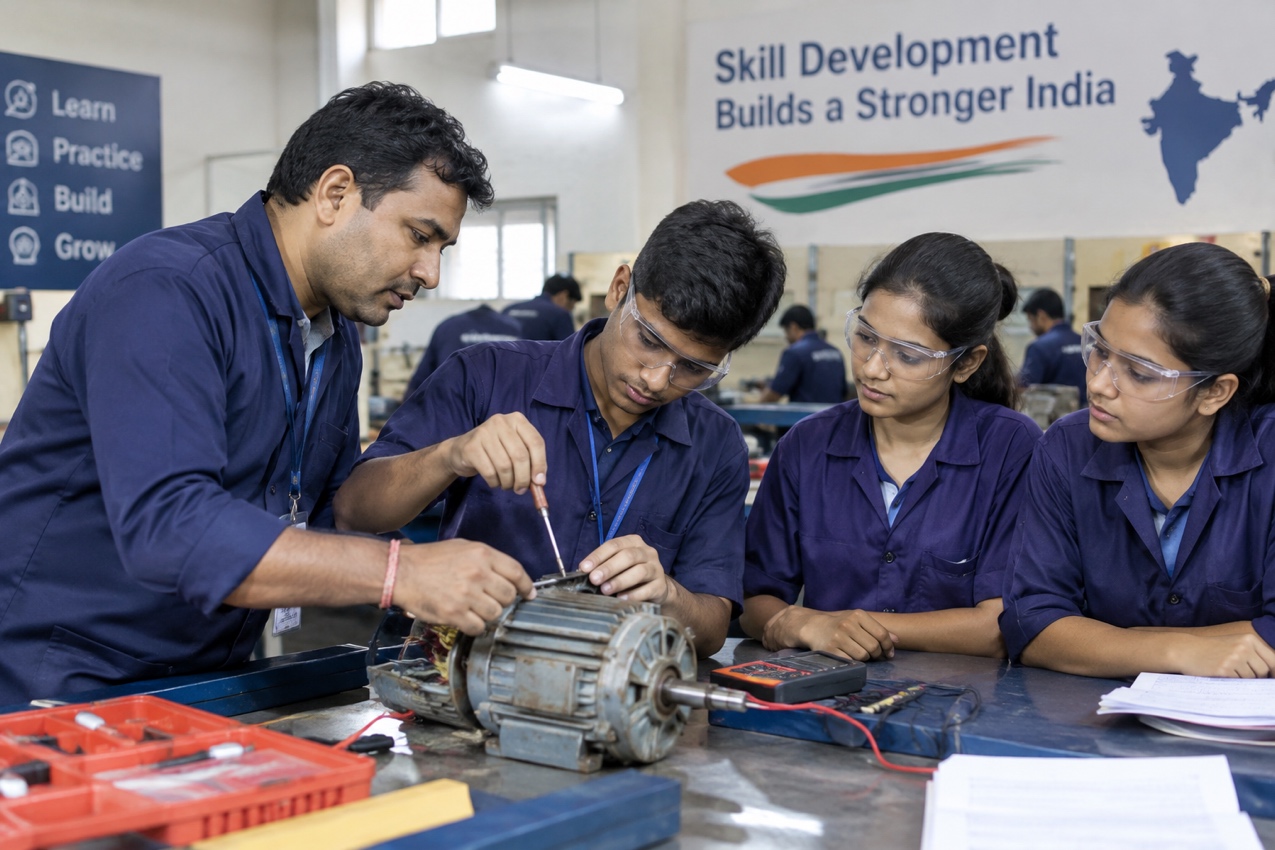
India has a lot of young people; according to an estimation it is 37 Crores. Over half of them are unemployed. Someone looked at that fact and said: let's train them. Let's skill them. Let's build a mission around it. Sounds good. Simple idea. Big number attached to it --- four hundred million people, trained by 2022. That number doesn't appear in official papers anymore. Nobody talks about it. It just quietly disappeared.
But the schemes built around that number are still running. PMKVY. DDU-GKY. NAPS. Billions of rupees. A decade of effort. So what happened?
Let's look at the facts.
Courses got shorter. Much shorter. Two-year courses used to be common. Now most courses are under six months. Some are ten days. Ten days to learn a skill that's supposed to get you a job.
Placement numbers look good on paper. The scheme claimed 54% placement. Real data says it's closer to 22%.; some programs yielded even below 10% . That's not a small gap. That's a different reality.
And here's the strange part. People trained formally are more unemployed than people who learned informally --- on the job, from family, by just doing the work. Four times more. Think about that. The formal system was supposed to fix the gaps in informal learning. Instead, it's doing worse.
So was the idea wrong? No. The idea was fine.
Skilling makes economic sense. Employers can't always tell who's actually skilled. Companies don't want to train workers who might leave for a competitor. These are real problems. A government stepping in to fix them --- that's reasonable.
There's even proof this can work. One part of the scheme --- recognising skills people already had --- was tested properly. An independent study checked it. Most people felt more confident. Incomes went up. Good result.
But that's one small piece. That's not the whole scheme. Nobody tested the whole thing properly before rolling it out to the entire country.
That's the real problem. Not bad intentions. Bad sequence.
They set the targets first. Millions of people to train. Then the budget. Then they built the machinery to hit those targets --- fast. Testing came later. Much later. In the form of an audit. After the money was already spent. After the young people had already gone through the training.
And what did the audit find?
Fake fingerprints, used to mark attendance for students who never showed up. Training centres that existed only on paper --- an address, nothing else. Bank account details for participants --- blank, fake, or nonsense --- in over 94% of the records checked. Almost all of it.
Most of the training targets --- 84% of them --- went to just 10% of the training providers. The big, well-resourced ones. Small, local NGOs barely got a look in, even though they were often closer to the communities that needed this training the most.
When officials were asked what went wrong, one answer stood out. They said the scheme was designed for "a perfect world." They hadn't accounted for middlemen. Or layers of bureaucracy. Or how things actually work on the ground in a country this size and this complex.
That's an honest answer. It's also an admission. Nobody stress-tested the design before unleashing it nationally.
So what should have happened instead?
Test small first. Before rolling out anything at national scale, run it in a few districts. Different kinds --- urban, rural, industrial, non-industrial. Set clear goals in advance. Not "how many people enrolled." Real goals --- did they get placed? Did they keep the job for six months? A year? Did their income actually go up?
Bring in outside experts. Not people connected to the scheme. People with no stake in making it look good. Let them evaluate it honestly, and let them say so publicly --- good or bad.
Check if it's actually workable, not just good on paper. Can states run this? Can local offices manage it? Will middlemen find a way to game it? Ask these questions before scaling, not after.
Scale slowly, and only based on results. Give more funding, more targets, to the partners and models that are actually delivering. Not to whoever can afford a bigger building or knows the right people.
And fix how people get paid. If a trainer gets paid just for enrolling students, guess what happens --- fake enrolments. If payment is tied to a student actually getting and keeping a job, the incentives change completely. This isn't complicated. It's basic design.
None of this is exotic. It's what any serious, technical field already does. A new drug gets tested in trials before it reaches the market. A bridge gets stress-tested before people drive over it. Skilling millions of young people deserves the same seriousness. Maybe more.
Because here's the thing about a failed pilot --- you can shelve it, learn from it, move on. Nobody really gets hurt.
A failed national mission is different. Its cost isn't just money, though that's real too. Its real cost is time --- the months and years that thousands of young people spent chasing a certificate, a stipend, a job that was never coming. That time doesn't come back. No audit report can give it back to them.
India will announce more big missions. That's certain, given the country's size and its needs. The real question is simple: will the next one be tested before it's trusted? Or will it, once again, be scaled first and understood only later --- through an audit, after the damage is already done.
Test first. Then trust. Then scale.
------------------------------------------------------------------------