Every year, millions of children carry a burden that begins before birth or in early childhood. This burden can be grouped into four parts. Defects present at birth. Diseases that strike in childhood. Deficiencies in nutrition. And delays in development. Together these four forces shape whether a child survives, and whether that child truly thrives.
Start with defects at birth. Nearly six in every hundred infants born worldwide carry some form of congenital defect. Each year this leads to about 240,000 deaths in the first month of life. A further 170,000 children die between one month and five years due to these defects. Heart defects are the most common and the most deadly among them. The good news is that global death rates from these defects have fallen sharply since 1990. But this progress is uneven. Poorer countries still carry a much heavier share of the burden. Detection remains slow in places with few specialists and little equipment.
Diseases of childhood tell a similar story. In 2024, close to five million children died before turning five. Nearly half of these deaths happened in the newborn period. Preterm birth and complications during delivery were the biggest causes. Beyond the first month, infections took over as the main killers. Malaria, pneumonia, and diarrhoea remain the deadliest. Malnutrition quietly worsens all of this. It weakens a child's defences and makes ordinary infections fatal. For the first time, researchers put a number on this. Over one hundred thousand children died directly from severe malnutrition in a single year. Most of these deaths were preventable with basic, low-cost care.
Deficiencies form a hidden layer beneath these numbers. Nearly two billion people worldwide lack one essential vitamin or mineral. Anaemia alone affects one in four people on earth. Among children, this number is even higher. Iron, vitamin A, and iodine deficiencies quietly damage growth and brain development. These are not dramatic deaths. They are slow, invisible losses. A stunted child today becomes a less productive adult tomorrow. Deficiencies rarely make headlines, but their long-term cost may be larger than any single disease.
Then comes delay. Delay in speech, in movement, in cognition, in social behaviour. Around fifty million children under five live with some form of developmental disability. Cerebral palsy and intellectual disability make up the largest share. Almost all of these children live in poorer countries. This is the cruellest twist in the story. Many of these children survived early illness because of medical progress. But no one measured whether they were developing normally afterward. Survival improved. Development did not keep pace.
These four problems are different in nature. But they share one common weakness. All of them depend on early detection. A defect caught early can be corrected. A disease caught early can be treated cheaply. A deficiency caught early can be reversed with simple supplements. A delay caught early can be managed through timely therapy. The tragedy is not that solutions don't exist. The tragedy is that detection comes too late, or does not come at all.
This is exactly where technology, and especially artificial intelligence, opens a new door. Traditional screening needs trained doctors, expensive machines, and functioning laboratories. Most children who need screening live in places that lack all three. AI changes this equation. It can bring expert-level judgment into a basic device that almost anyone can use.
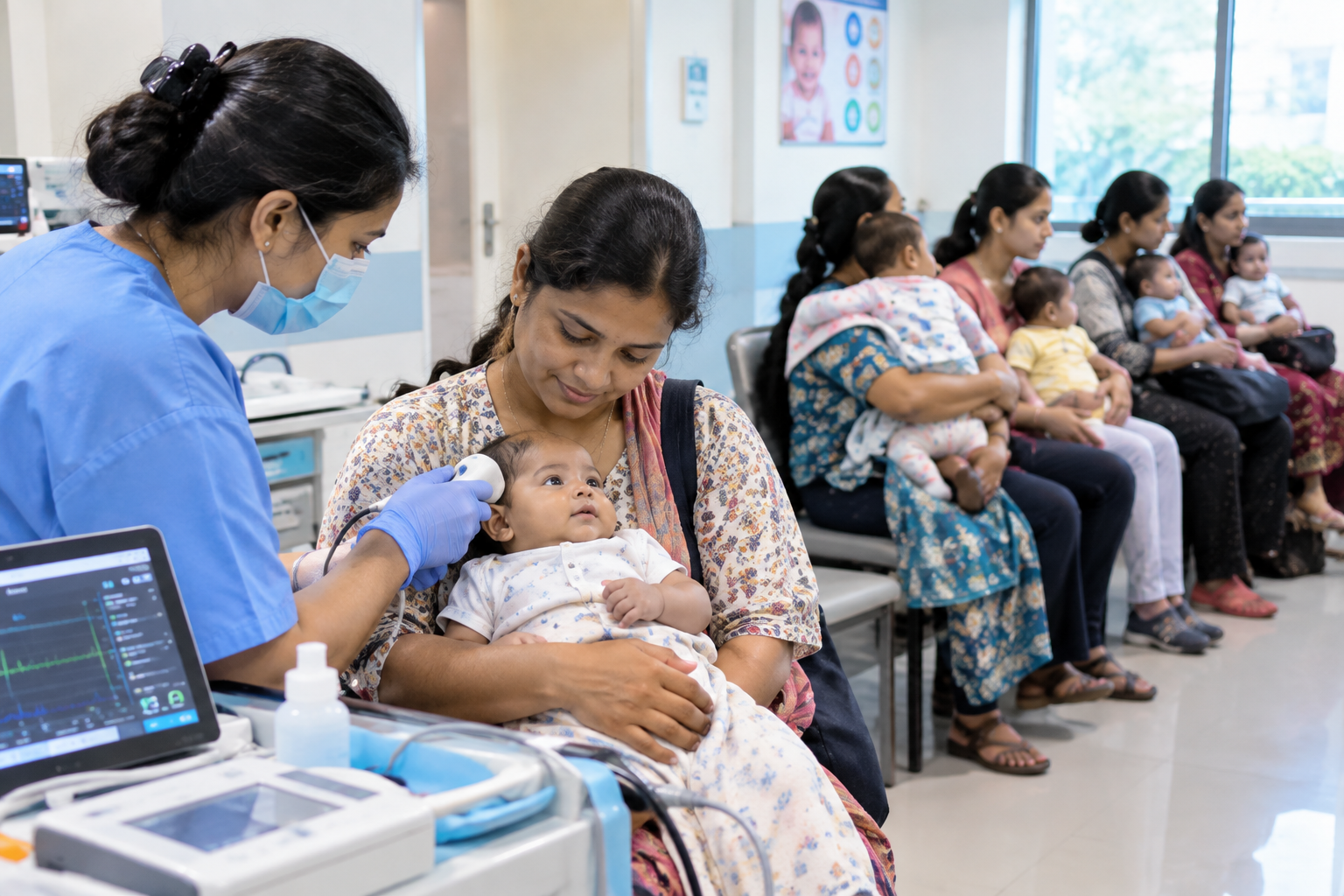
Take heart defects as an example. AI can now read ultrasound images and flag abnormal hearts with high accuracy. It does not replace the doctor. It supports a nurse or technician who lacks years of specialist training. This means a heart defect can be caught in a small clinic, not just in a city hospital.
Take childhood infections next. AI-based tools can analyse a cough, a lung sound, or a blood smear image. They can flag pneumonia or malaria within seconds. This shortens the gap between symptom and treatment. In diseases that kill quickly, this gap is often the difference between life and death.
Take deficiencies. This is perhaps the most striking use of AI so far. Researchers have built apps that read a photo of the inner eyelid and estimate haemoglobin levels. No blood draw is needed. No laboratory is needed. Just a smartphone camera and an algorithm. Such tools have already been tested on thousands of people, including children, with promising accuracy. This could turn anaemia screening from a rare hospital event into a routine community check.
Take developmental delay. This may be the hardest of the four to detect, since it depends on subtle behaviour rather than a single test. Yet AI is making progress here too. Some tools use a phone's front camera to study a toddler's gaze while watching a short video. Children with autism tend to look at objects differently from children without it. Machine learning can pick up this pattern early, long before a specialist would normally be consulted. Similar tools use short home videos of simple tasks, like responding to a name or imitating an action, to flag early risk. These tools are still developing, but they point toward a future where every child can be screened, not just those lucky enough to reach a specialist.
The deeper value of these technologies is not the technology itself. It is what they replace. They replace waiting. They replace geography as a barrier. They replace the assumption that good screening needs a big hospital. A single smartphone, loaded with the right AI tool, can do what once required a team of specialists and a well-equipped clinic.
There is also a quieter benefit. Every AI screening leaves behind data. This data can show where problems are concentrated. It can guide where resources should go next. In this way, technology does not just treat individual children. It helps a health system understand itself better over time.
None of this removes the need for real doctors, real nurses, real supply chains, and real investment. AI tools are only as useful as the system built around them. A smartphone cannot deliver medicine. It cannot perform surgery. It cannot replace a mother's access to clean food and clean water. But it can tell a health worker exactly where to look, and it can do this early, cheaply, and at a scale no army of specialists could match on their own.
This is the real promise of investing in high-end technology and AI for these four burdens. Not a replacement for care, but a multiplier of it. Every dollar spent on early detection saves many more dollars spent on late-stage treatment. Every year of delay avoided adds years of productive life to a child's future. In a problem shaped by scale and by time, technology's greatest gift may simply be this: it lets a system see a problem before it becomes permanent.